
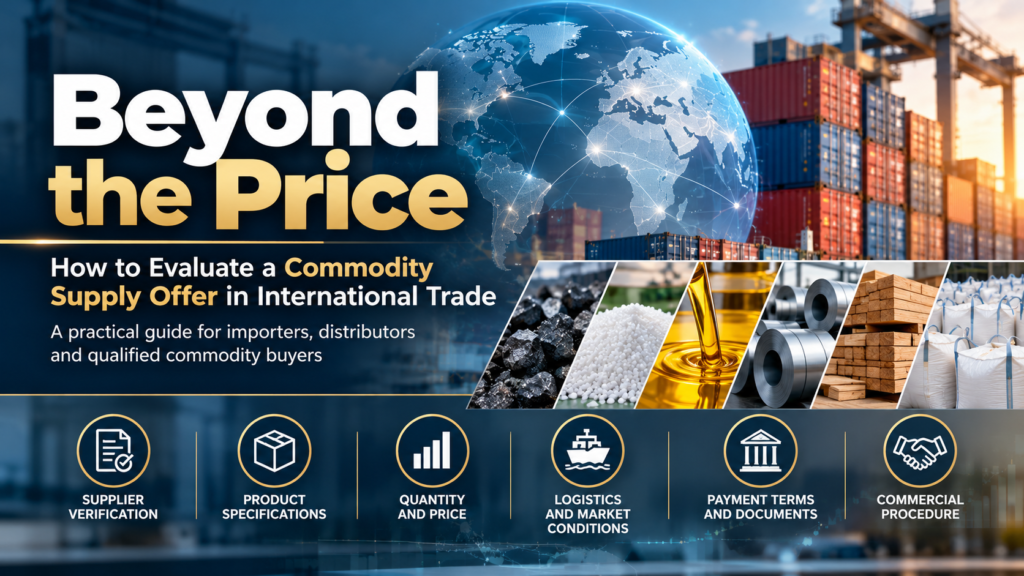
A practical guide for importers, distributors and qualified commodity buyers
In international commodity trading, an attractive price is only the starting point. A successful transaction also depends on supplier verification, clearly defined commercial terms, appropriate payment arrangements, reliable logistics and transparent communication between the parties.
For buyers sourcing agricultural products, food commodities, fertilizers, minerals, metals and energy-related raw materials, evaluating the complete offer is essential before moving forward with a transaction.
1. Verify the supplier and the commercial chain
Before proceeding, buyers should understand who is offering the product, who owns or supplies it, and which companies or intermediaries participate in the transaction.
A professional verification process may include:
- Checking the supplier’s legal identity and registration.
- Confirming the authority of the person representing the seller.
- Reviewing relevant product specifications and supporting documentation.
- Establishing the roles of brokers, mandates and commercial facilitators.
- Confirming that the proposed transaction follows the seller’s documented procedure.
Certifications, registrations and memberships should be checked against the relevant issuing organization or official register. Their presence alone does not guarantee product availability, shipment performance or the successful completion of a transaction.
2. Evaluate the complete commercial offer
A commodity offer should provide sufficient information for the buyer to determine whether the opportunity matches its requirements.
Key elements include:
- Product specifications: grade, quality, origin and applicable technical requirements.
- Quantity: minimum order quantity, maximum available quantity and shipment size.
- Price: currency, unit of measurement, validity period and any applicable conditions.
- Incoterms®: the agreed delivery rule, named place or port, and the responsibilities allocated to each party.
- Packaging: bulk or packaged cargo, including the required packaging specifications.
- Delivery schedule: expected shipment window, loading port and destination.
- Payment terms: agreed banking instrument, documentary requirements and payment conditions.
Buyers should ensure that all these elements are consistent across the offer, purchase contract and relevant banking documents.
3. Understand logistics before committing
International commodity transactions depend on more than the product itself. Freight costs, port capacity, transit times, cargo handling and shipping routes can affect the overall commercial viability of a purchase.
UN Trade and Development (UNCTAD), in its Review of Maritime Transport 2025, highlighted the impact of changing trade routes, geopolitical uncertainty and volatile freight costs on maritime trade. These factors reinforce the importance of evaluating logistics as part of the sourcing decision.
Reference: https://unctad.org/topic/transport-and-trade-logistics/review-of-maritime-transport
Before proceeding, buyers should confirm the proposed loading and destination ports, the applicable Incoterm, the shipment schedule and the allocation of freight, insurance and other costs under the agreed delivery terms.
4. Review payment instruments and documents carefully
Payment arrangements should be agreed before a transaction advances to the banking stage.
Where a documentary credit or another bank instrument is proposed, the parties should establish the instrument’s purpose, amount, beneficiary, validity, required documents and payment conditions. The buyer’s bank should review the proposed wording and confirm whether the instrument is acceptable before issuance.
The International Chamber of Commerce provides guidance on documentary credits and the UCP 600 framework used in international trade finance.
Buyers should also confirm that the payment mechanism corresponds to the agreed shipment structure. For example, a contract covering multiple shipments may require clearly defined documentary and payment arrangements for each delivery.
No party should assume that a banking instrument guarantees the quality of the goods or eliminates the need for commercial, documentary and counterparty due diligence.
5. Establish a clear transaction procedure
A structured procedure helps all parties understand what is required at each stage.
Depending on the seller’s requirements, the process may include:
- Submission of the buyer’s initial inquiry and company information.
- Review of the offer and confirmation of commercial interest.
- Submission of the required buyer documentation.
- Verification and approval of the proposed transaction by the relevant parties.
- Review and agreement of contractual and banking terms.
- Execution of the contract and completion of the agreed payment and shipping procedures.
The exact sequence will vary according to the seller, commodity, transaction structure and applicable legal and banking requirements. Buyers should obtain the official procedure directly from the authorized commercial party and have independent advisers review significant contractual or financial commitments.
6. The role of a commercial facilitator
In international commodity markets, commercial facilitators can help connect buyers with potential suppliers, communicate offer details and coordinate the exchange of information between the parties.
However, the facilitator’s role must be clearly distinguished from that of the product owner, seller, exporter or contractual supplier.
Consultoría SYO COL SAS acts as a commercial facilitator and intermediary. We do not own or hold the commodities offered, do not invoice buyers for the products, and do not sign product purchase and sale contracts with buyers. Our remuneration is paid by the seller under the applicable commercial agreement.
Product availability, specifications, pricing, seller documentation and transaction terms remain subject to confirmation by the relevant seller and the agreed procedure.
This distinction helps establish transparent expectations and allows buyers to identify the parties responsible for the product, contractual obligations, documentation and payment arrangements.
Conclusion: Due diligence is part of the sourcing strategy
A competitive commodity offer should be evaluated through a complete commercial framework—not price alone.
Supplier verification, consistent documentation, realistic logistics, clearly defined payment terms and transparent responsibilities help buyers make informed decisions and reduce avoidable risks.
At Consultoría SYO COL SAS, we believe that professional communication and a structured approach to international sourcing are essential to building productive commercial relationships.
Are you sourcing agricultural commodities, food products, fertilizers, minerals or other raw materials for your business?
We welcome inquiries from qualified buyers, importers, distributors and commercial partners interested in exploring international supply opportunities.
🌐 Website: https://consultoriasyocolsas.com
✉️ Email: info@consultoriasyocolsas.com
📱 WhatsApp: +57 314 3363442
All offers are subject to seller confirmation, availability, due diligence and the applicable commercial procedure.