
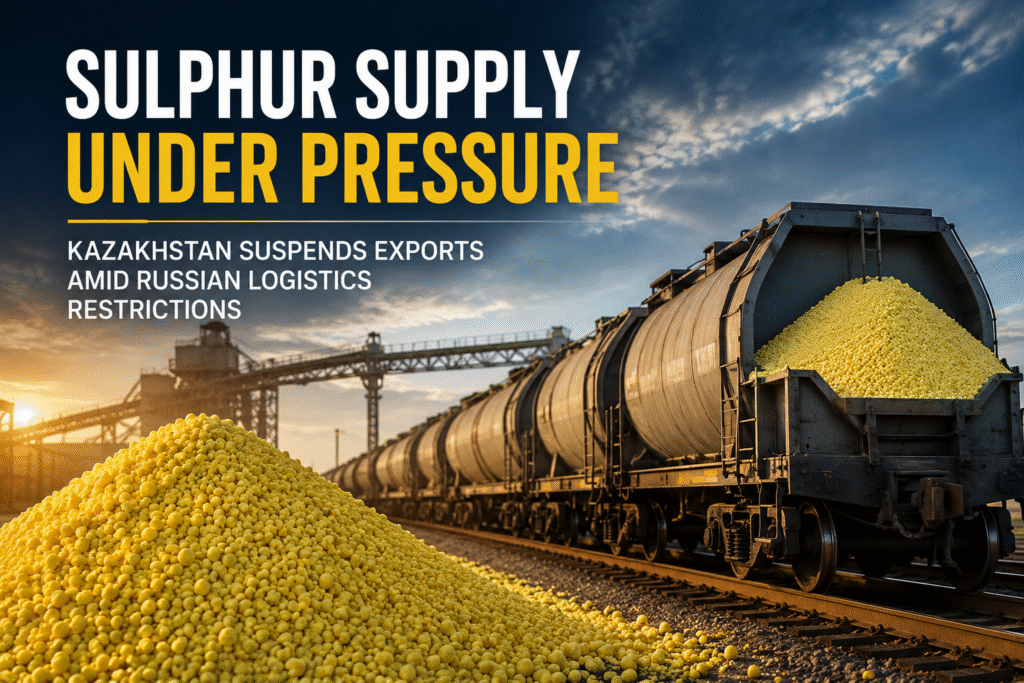
The global sulphur market has entered another period of uncertainty.
In a move that is expected to impact fertilizer manufacturers, mining companies, and industrial buyers worldwide, Kazakhstan has suspended sulphur exports effective June 27, 2026, while Russia has extended its own export restrictions through the end of the year.
Why is this happening?
Kazakhstan is one of the world’s leading producers of granular sulphur, with much of its production originating from the Tengiz and Kashagan oil fields.
Historically, a significant portion of Kazakh sulphur exports has relied on Russian railway infrastructure and Russian ports to reach international markets.
However, Russia has imposed restrictions on rail movements and export logistics while prioritizing domestic supply and national interests. As a result, Kazakhstan’s ability to move sulphur to overseas markets has been severely affected.
Immediate consequences for the international market
The implications are already being closely monitored by commodity traders worldwide:
✔ Reduced global availability of granular sulphur
✔ Increased pressure on international prices
✔ Greater competition among buyers for available cargoes
✔ Potential supply chain disruptions for fertilizer manufacturers
✔ Higher procurement costs for industrial consumers
For importers, securing reliable suppliers and well-structured contracts has become increasingly important.
Why does this matter?
Sulphur is an essential raw material for:
- Phosphate fertilizers
- Sulphuric acid production
- Copper and nickel processing
- Chemical manufacturing
- Industrial refining
Any disruption affecting major producing countries immediately impacts global supply chains.
With Russia restricting exports and Kazakhstan limiting international shipments, the market is experiencing one of the tightest supply conditions in recent years.
What should buyers do?
Periods of supply uncertainty require disciplined procurement strategies.
Professional buyers should prioritize:
- Verified supply sources
- Transparent transaction procedures
- Proper Proof of Product (POP)
- Strong contractual documentation
- Experienced commercial facilitators capable of coordinating international transactions
In today’s market, security of supply is becoming just as important as price.
Looking Ahead
The sulphur market is likely to remain under pressure as long as logistical restrictions and export controls continue.
Companies that establish dependable supply chains and work with experienced international partners will be in the strongest position to navigate this evolving market environment.
At Consultoría SYO COL SAS, we continue to facilitate international commodity transactions with transparency, professionalism, and a commitment to connecting serious buyers with reliable supply opportunities.